echo-words
A private vocabulary tutor for every word you meet. Send a word, a phrase or a whole sentence, and echo-words explains what a dictionary will not — then writes the flashcard for you, into the Anki deck you already review. It explains; Anki makes you remember.
A word, a phrase, a sentence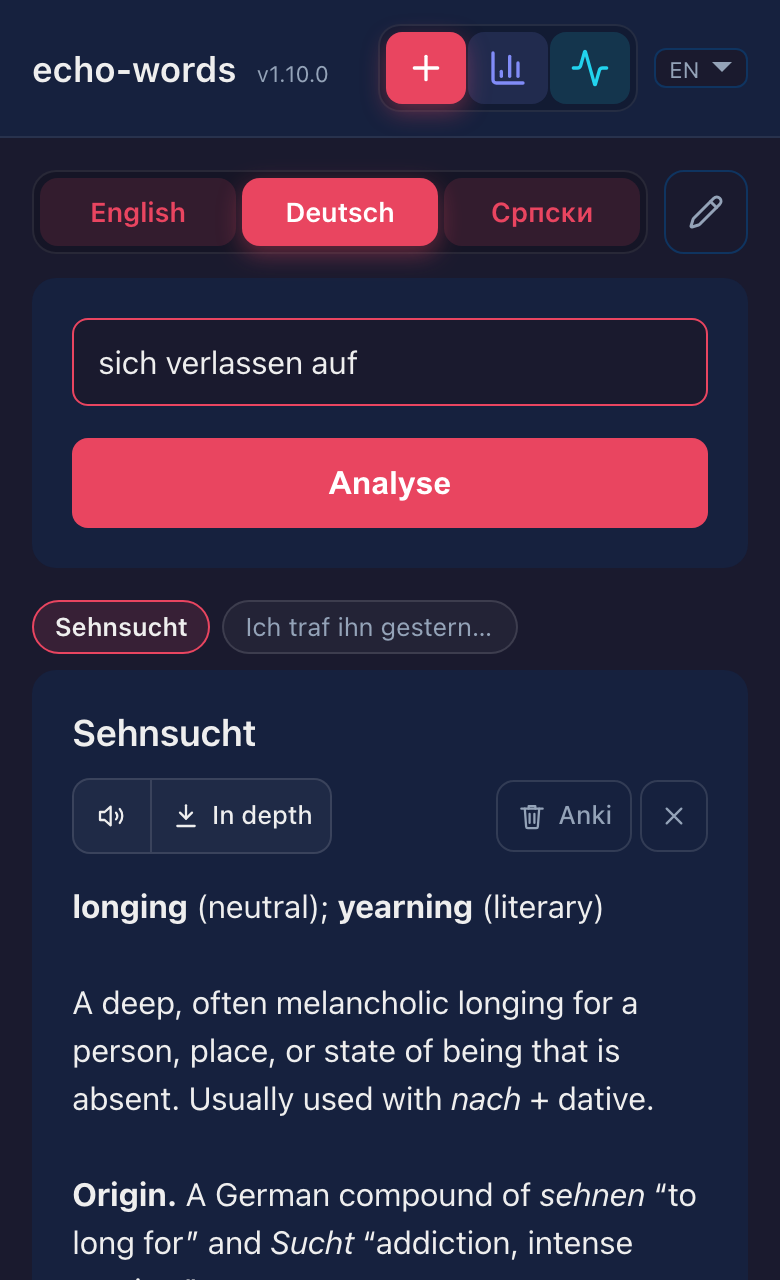 |
Analysis, audio, card in Anki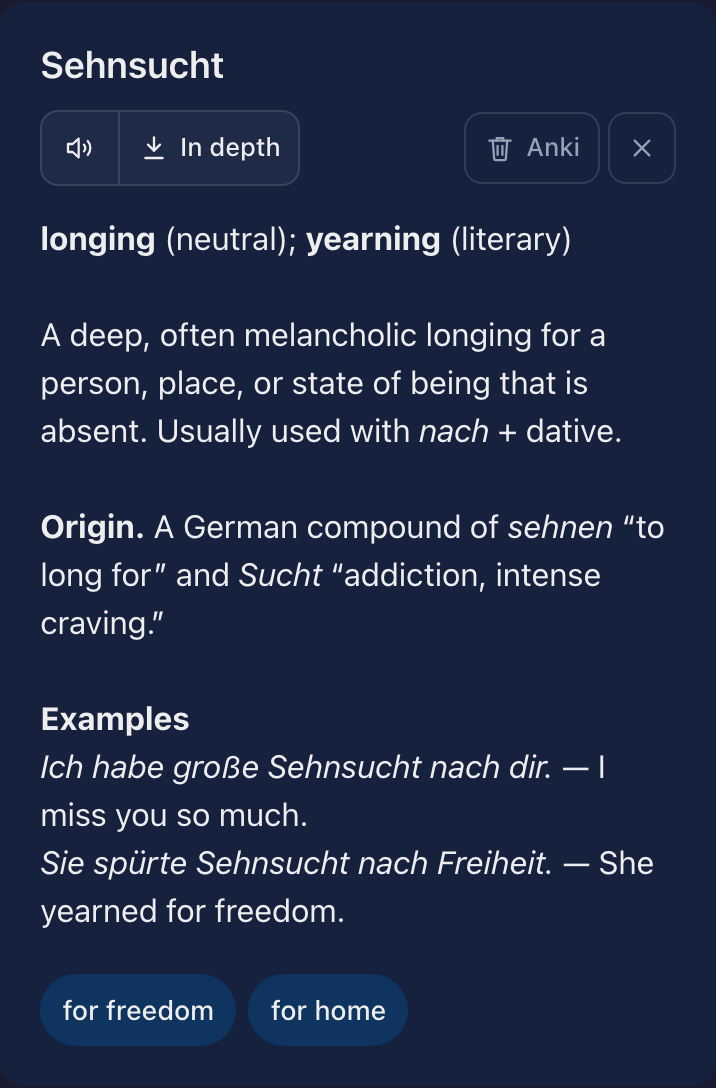 |
A sentence, translated and explained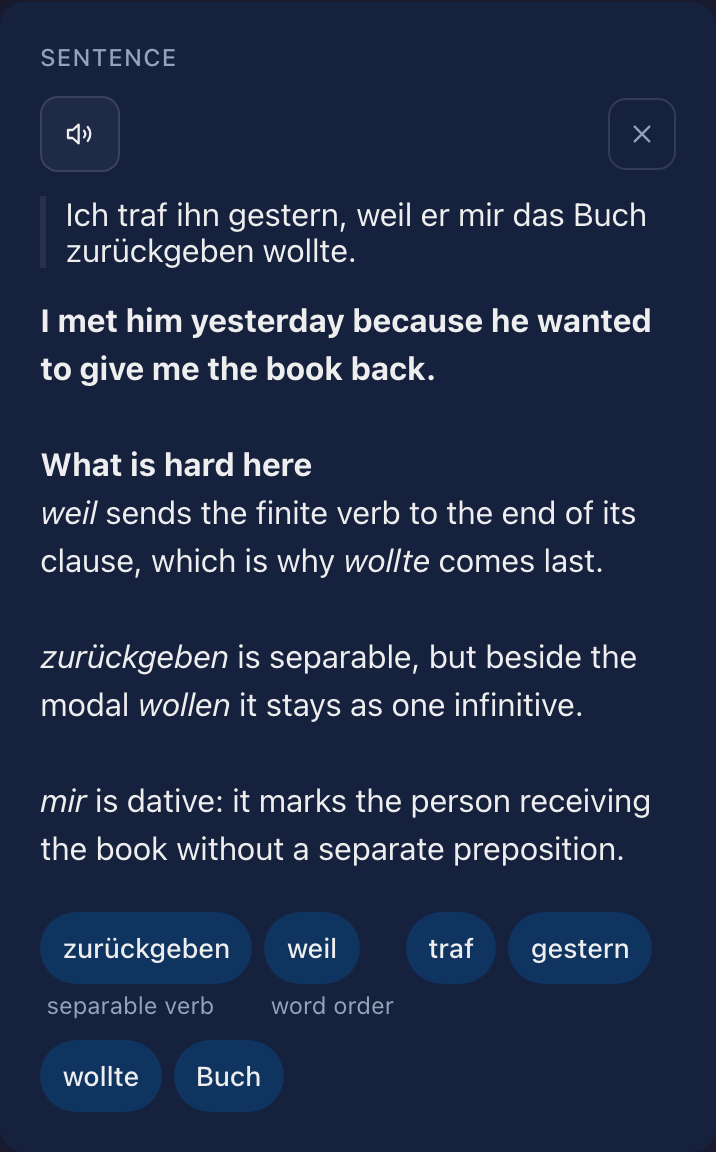 |
- Understand the word: its senses, register, collocations and translated examples, and the sense you choose to learn.
- Learn from a sentence: a translation, the hard parts explained, and every word one tap away.
- Keep it in Anki: four cards for each sense, with a real voice, in the decks you already review.
Quick start
echo-words is a small server of your own, and the app on your phone is the page it serves. Running it costs nothing: Oracle's Always Free VM, Tailscale's free plan and a free Gemini key.
Have Claude Pro or Max, or ChatGPT Plus? Open the Code tab of the Claude desktop app, or Codex in the ChatGPT desktop app, and paste:
Install echo-words on Oracle Cloud for me, following
https://andgineer.github.io/echo-words/agent-install/
The agent tells you each step only you can do — signing up for Oracle and Tailscale, putting your keys in a file — and does the rest.
- Get your keys: one free Gemini key is enough.
- Create the free VM and join it to your Tailscale network.
- Write the VM's address, your keys and your AnkiWeb login into
.deploy/.env, then runuv run inv setup-app --with-host-preponce anduv run inv deploy --ref=main, as Install on Oracle Cloud describes. - Install the app on your phone, and add the share-sheet Shortcut if you want it.
- Choose your languages in the app. It starts with English, German and Serbian, each with its own Anki deck and voice.
Try it on your computer to see what it does. It runs only while you keep it running, only the browser on that computer opens it, and its cards stay in a trial collection that none of your Anki apps see.
What it does
- an explanation, not a translation — every target-language-distinct sense with its register, the collocations and prepositions the word takes, what it is confused with, its origin, and examples with their translations; an idiom or phrase is explained as a whole and also offers its component words as chips
- the sense you actually met — a word looked up out of a text is explained in that text's sense, not replaced by the nearest dictionary meaning
- one selected sense, reviewed four ways — the unit and its translations are asked in both directions, then its example is asked once highlighted and once gapped; every sense remains available as a chip for a separate note
- a real voice, not a robot — natural-sounding audio, locally with Piper or online with edge-tts, in the app and on the card; whatever you send is voiced whole, so a word taken out of a sentence is played beside that sentence
- a whole sentence gets a lesson instead — translated, with what is hard in it explained, and every word plus the expressions worth learning offered as chips; tapping one creates its own four-card note
- a deeper entry when you want one — one tap re-asks the strongest model for a lexicographer's article: every sense including the rare ones, etymology in depth, near-synonyms, the mistakes learners make
- nothing to pay — a pool of free LLM providers answers; a paid model is optional and capped, and on the author's own use it costs about half a dollar a month
It keeps no database: your Anki collection is the only thing it stores.
Any language, any script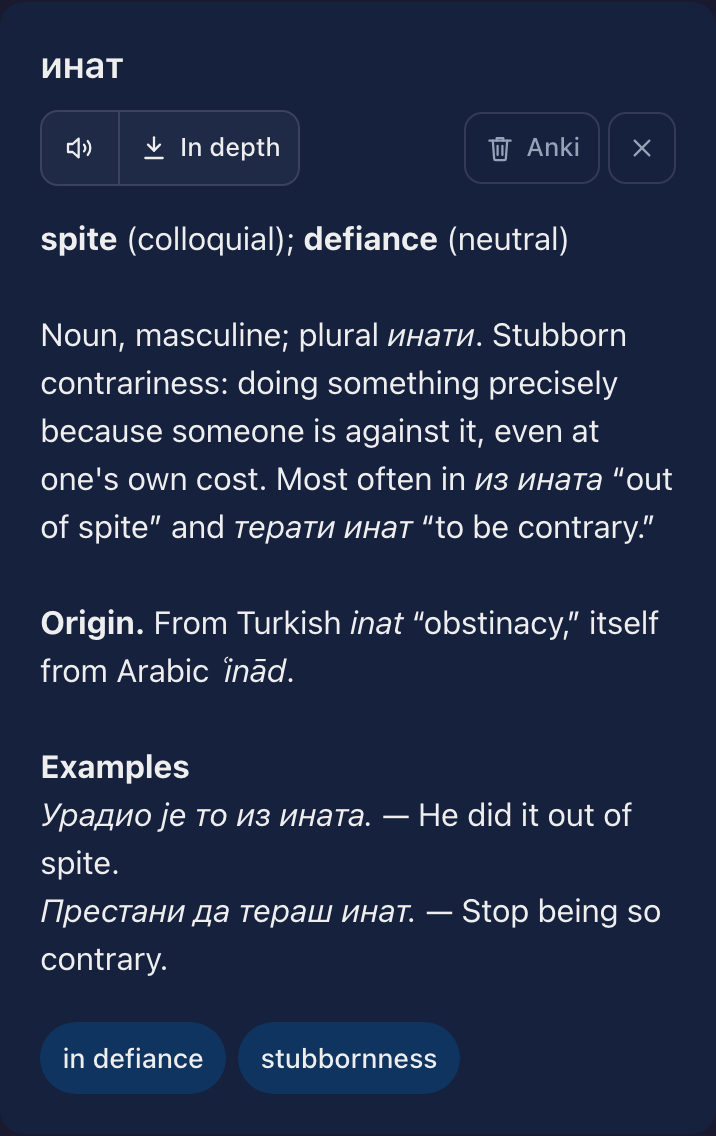 |
What went into the decks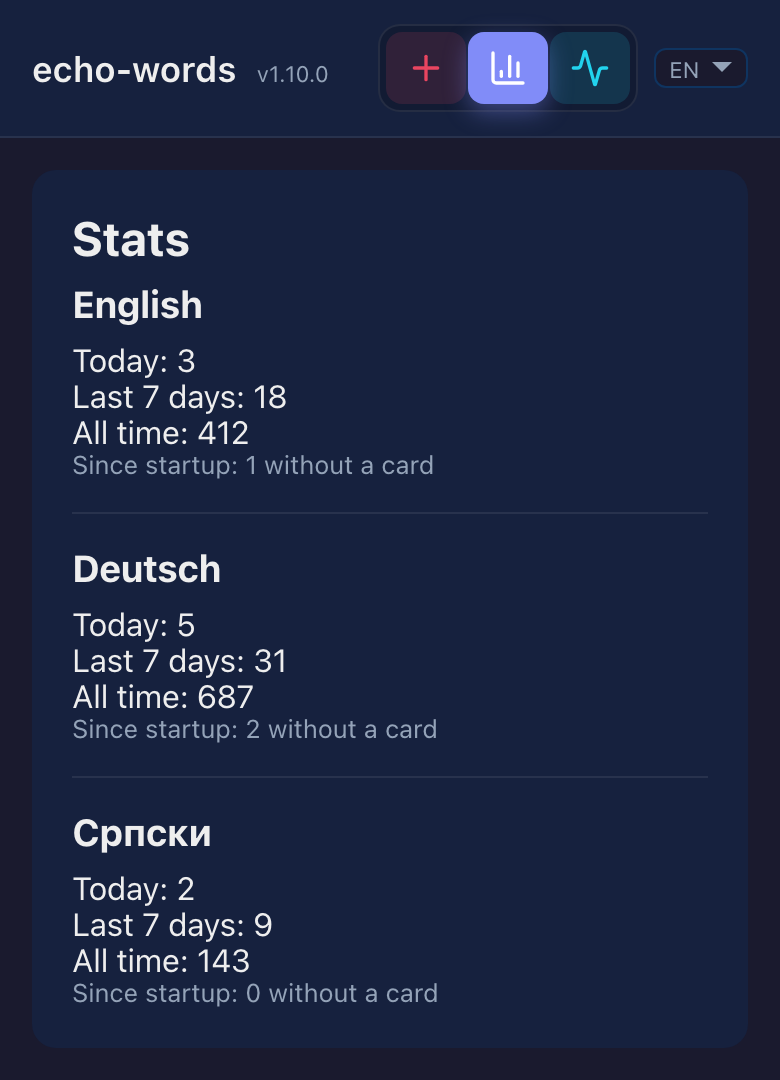 |
Providers, sync, and cost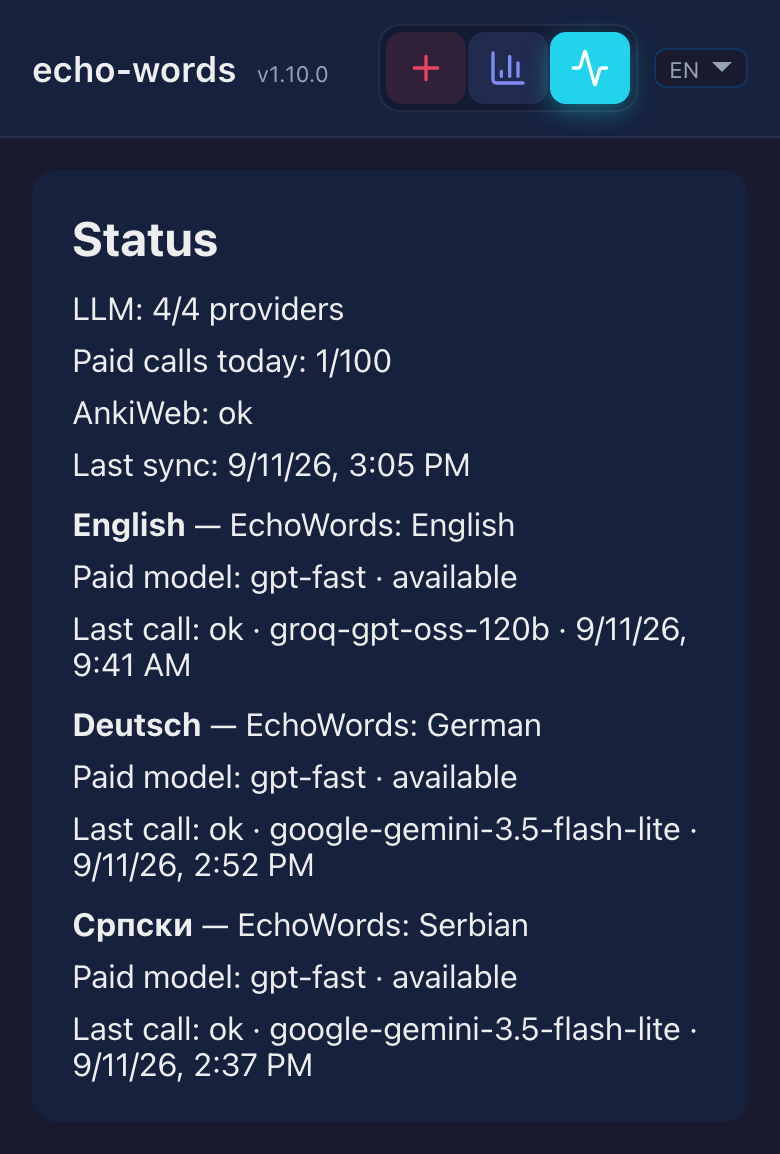 |
Under the hood
Getting a complete answer from a changing model pool. Free LLM providers vary in availability, speed, and instruction-following. Through llmbroker, echo-words races two models and selects the first complete, usable answer. Streaming lets the reader start earlier; recovery preserves an existing explanation if card creation fails.
Checking what the cards actually teach. Valid JSON can still contain the wrong meaning, an invented origin, or a word from the wrong language. Model-facing changes go through real-model benchmarks and a separate agent's review of the concrete answers. The evaluation records document both findings and remaining limitations.
Keeping the backend operational in less than 1 GB. FastAPI serves the Vue PWA and maintains Anki through its headless Python library, syncing directly with AnkiWeb. There is no separate application database or running Anki desktop instance. Access to the web app is restricted to a Tailscale network.